Scorched-earth policy of paramilitary groups burns and reshapes Darfur, resulting in famine, ethnic cleansing and demographic change
Since the start of the civil war in Sudan, the Rapid Support Forces and allied Arab militias have set fire to hundreds of villages, in order to accelerate their depopulation
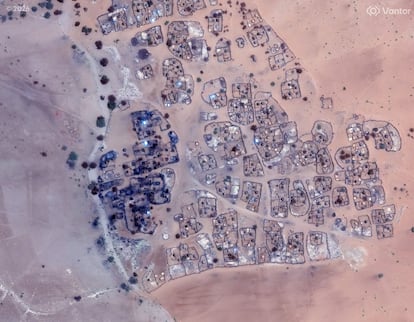

Hajj Kater, a Sudanese activist from El Fasher — the capital of North Darfur — recently reunited with his old friend Ali at the hospital in Tiné, a town on the Sudanese-Chadian border. His former classmate was receiving treatment for injuries sustained when fighters who were apparently affiliated with the Rapid Support Forces (RSF) forcibly seized his village, Shartiba, in mid-March.
Kater doesn’t know how many people lived in the village, but based on accounts from friends and acquaintances, he estimates that there were between 13 and 20 families. All those who survived the attack fled to displacement camps in eastern Chad, knowing they may never return. Their village had been burned to the ground as part of the paramilitary offensive around the city of Karnoi, one of the last remaining areas of North Darfur not yet under their control.
“The RSF are burning villages indiscriminately, attacking houses according to their own criteria,” Kater reports over the phone. “They might attack the house of the village chief, a local leader, or some other official. Sometimes, they attack houses that appear well-built but are actually made of straw, which causes the wind to spread the fire to neighboring houses, sometimes even razing entire villages,” he observes.
These are not isolated incidents. Since the outbreak of civil war in Sudan three years ago, on April 15, 2023, up to January 10 of this year, researchers at Sudan Witness — part of the Center for Information Resilience (CIR) — have recorded more than 750 fires across Darfur, a region roughly the size of Spain. These fires have affected 357 settlements, villages, or towns, according to data shared with EL PAÍS.
Although not all of the aforementioned fires can directly be attributed to RSF fighters and allied Arab militias, they’re considered responsible in most cases. The paramilitaries — alongside local armed groups within their sphere of influence — have a long history of arson in Darfur. This scorched-earth policy is integrated into their ethnic cleansing campaigns, which have once again been unleashed in the context of the current civil war.
“Any area attacked by the RSF becomes uninhabitable,” Kater observes. He notes that many of the razed villages had previously been marginalized by the central government, so “nobody knows about them unless you go there in person.”
“Many haven’t even been included in the historical record; they’ve been erased from the map,” he laments.
Ethnic cleansing
North Darfur — one of the five Sudanese states that make up Darfur — is where the largest number of arson attacks are concentrated, according to data shared by the CIR. It was the last state in the region to fall to the RSF, largely due to the tenacious resistance of local armed groups in the capital, El Fasher. The city was occupied at the end of last October, after one of the worst massacres of the Sudanese war and recent history, which followed a siege that lasted more than 500 days.
But North Darfur isn’t the only state where apparent arson attacks on towns have been documented. In South Darfur, Central Darfur and West Darfur, more villages have been razed by fire, according to CIR data. These scorched-earth tactics have also spread to the Kordofan region in south-central Sudan, another major front in the war.
Of the over 350 villages burned in the Darfur region, 140 suffered fires on at least two occasions, while 25 were set ablaze five times or more, according to the CIR. This suggests a more evident intent to devastate certain communities. For example, 80 fires have been recorded in El Fasher, with as many as 27 recorded in El Geneina, the capital of West Darfur and the historical capital of the Masalit community (a minority ethnic group), which was captured by the RSF in 2023.
In many incidents, it’s difficult to determine who started the fires or whether they were intentionally set. Human rights groups have also documented cases in Darfur where deliberate fires resulted from clashes between Arab tribes affiliated with the RSF. In other instances, the fires coincided with bombings by the regular army or isolated, criminal attacks, particularly in roadside villages.
Even so, the scorched-earth policy practiced by the RSF and allied Arab militias — as part of their ethnic cleansing campaigns — is evident on a large scale. In July of 2023, Human Rights Watch (HRW) identified seven torched villages and several settlements of displaced people in West Darfur, inhabited primarily by the Masalit people. These attacks also occurred in parallel with the offensive in El Geneina, where between 10,000 and 15,000 people were killed.
Another incident in West Darfur occurred in the town of Sirba, inhabited mainly by the Erenga people, who belong to another non-Arab tribe in the region. In late July of 2023, large fires broke out in the town. Most of it ended up being burned to the ground, according to the CIR. The RSF and Arab militias were widely blamed for the fires, with the Darfur Bar Association reporting more than 460 deaths and over 1,000 injuries.
After gaining control of the rest of the region, the RSF turned its offensive toward North Darfur in early 2024. Between April and June of that year, 38 settlements near El Fasher were damaged by fires that, in most cases, destroyed more than half of their total area, according to the CIR. Later that year, 50 settlements in the Kutum area — inhabited mainly by the Zaghawa people — were also affected by fires.
In southern El Fasher, in the Dar As Salam area, researchers from Sudan Witness have identified more than 40 settlements that were damaged by fire between December of 2024 and April of 2025. That same April, the RSF and allied militias stormed Zamzam, a displaced persons camp housing half a million people, located between Dar As Salam and El Fasher. Part of the camp, including the central market, was also burned.
Man-made famine
The burning of specifically agricultural villages by the RSF has also been a central element of the deliberately induced famine in parts of the Darfur region. Between April and mid-June of 2024, at the start of their offensive against El Fasher, the paramilitaries burned 41 farming communities north and west of the North Darfur capital, according to the Yale School of Public Health Humanitarian Research Lab (HRL).
In a recent study based on the analysis of satellite imagery and remote sensing data, HRL researchers found that, in the period following these attacks, there was a substantial decrease in agricultural activity in these villages. Their production was especially important, as they were part of El Fasher’s fragile food security ecosystem.
Within a 1.2-mile radius of the studied villages, the total area dedicated to crops decreased by an average of 82% after the fires, representing a deliberate and near-total collapse of the sector. The HRL study also identified partial or total damage to livestock pens in 20 of these communities. All of the attacks coincided with the start of the siege of El Fasher.
Furthermore, paramilitaries surrounded El Fasher with an earthen wall more than 46 miles long, preventing humanitarian aid from reaching the city. This siege — coupled with artillery attacks and constant ground incursions — meant that the limited food that trickled into the city came via smuggling routes.
The Integrated Food Security Phase Classification (IPC), an initiative that monitors global hunger, declared a famine in the Zamzam displacement camp, south of El Fasher, in August of 2024. In December of the same year, it concluded that this threshold had also been crossed in the Abu Shouk and Al Salam camps, both located within the state capital.
Demographic shift
The deliberate burning of villages in Darfur was already a widespread crime during the bloodiest years of the brutal offensive and ethnic cleansing campaign led by predominantly Arab militias. In the early 2000s, the central government in Khartoum used these groups to quell an armed uprising against its repression and sectarianism. Some of those militias later became institutionalized, forming the Rapid Support Forces (RSF).
As is happening now, the Janjaweed — a common (albeit vague) term used to refer to primarily Arab tribal militias — resorted to scorched-earth tactics to depopulate areas that were traditionally inhabited by other ethnic groups, such as the Fur, Masalit, and Zaghawa peoples. Although violence decreased after 2005, the attacks never stopped. And most of the displaced populations never returned to their lands.
A prominent defender of human rights in Darfur — who is currently living in Uganda — spoke with EL PAÍS on the condition of anonymity, for security reasons. He explained that now, once again, some of the land that was forcibly depopulated by the RSF and allied militias, including through the use of arson, is being used for grazing. Many of Darfur’s Arab tribes are pastoralists, which has traditionally led to land disputes with Indigenous farming groups.
“In this war, the RSF continues to exacerbate this demographic shift,” he notes. “If we focus on West Darfur, we see that most of the Masalit tribe is already gone: they remain in some very small villages, but they’re no longer in the capital, Geneina, or in wealthier areas like Habila. And yet,” he adds, “we’re seeing Arabs.”
Sign up for our weekly newsletter to get more English-language news coverage from EL PAÍS USA Edition
Tu suscripción se está usando en otro dispositivo
¿Quieres añadir otro usuario a tu suscripción?
Si continúas leyendo en este dispositivo, no se podrá leer en el otro.
FlechaTu suscripción se está usando en otro dispositivo y solo puedes acceder a EL PAÍS desde un dispositivo a la vez.
Si quieres compartir tu cuenta, cambia tu suscripción a la modalidad Premium, así podrás añadir otro usuario. Cada uno accederá con su propia cuenta de email, lo que os permitirá personalizar vuestra experiencia en EL PAÍS.
¿Tienes una suscripción de empresa? Accede aquí para contratar más cuentas.
En el caso de no saber quién está usando tu cuenta, te recomendamos cambiar tu contraseña aquí.
Si decides continuar compartiendo tu cuenta, este mensaje se mostrará en tu dispositivo y en el de la otra persona que está usando tu cuenta de forma indefinida, afectando a tu experiencia de lectura. Puedes consultar aquí los términos y condiciones de la suscripción digital.