Spain working on new Africa policy that looks beyond immigration
The first comprehensive plan in five years is seeking to boost Spanish investment in the continent

The Spanish government is this week taking to Congress a new strategy for Africa that focuses on investment, peace missions, a greater business presence, and what it terms “orderly mobility” between the continent and Spain.
Following a five-year hiatus on the issue, Spain is finalizing a new comprehensive plan for Africa, said sources at the Foreign Ministry. According to these sources, the Socialist Party (PSOE) government of Prime Minister Pedro Sánchez wants to create a more productive relationship that looks beyond the issue of irregular immigration to address political stability, peace and security, economic growth, and sustainable development on the continent.
Barely 0.3% of Spain’s gross foreign investment went to Africa last year
The document does not use the word immigration, alluding instead to “orderly mobility.” One high-ranking ministry official said that “we need to broaden the approach, because immigration is a shared reality. Of every five Africans who emigrate, four do so within the continent itself. Fewer than 20% arrive in Europe.”
This is the first comprehensive Africa plan developed by a Spanish government since José Luis Rodríguez Zapatero, also from the PSOE, produced one for the 2009-2013 period. Before that, there had been two plans, one in 2000 and another one in 2006, although these focused largely on containing immigration.
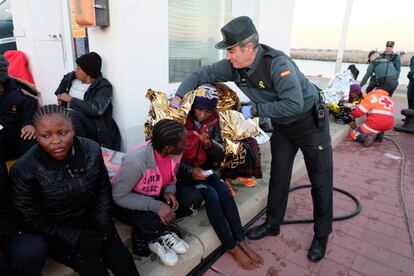
Due to its geographical proximity to the northern coast of Africa, where it has the exclave cities of Ceuta and Melilla, Spain has been a traditional entry point into Europe for migrants. Since November 1, 1988, 6,714 people have died or gone missing in the Strait of Gibraltar, according to a report by the migrant support group Andalucía Acoge.
The document does not use the word immigration, alluding instead to “orderly mobility”
The new plan, which lacks a specific budget, wants to promote Spanish investment in Africa, where there are currently only around 600 Spanish businesses in operation. The government wants to spend more on showcasing a vision of Africa that looks beyond the news stories of war, drought and dictatorship, to underscore the fact that the continent is less poor and more stable now than it was years ago.
Barely 0.3% of Spain’s gross foreign investment went to Africa last year, and half of that was aimed at South Africa, according to Economy Ministry figures. Other European Union members such as France and Italy have a greater presence in the region. The EU has come up with an investment tool that hopes to direct €44 billion at Africa, mostly in private funds, over the next few years. Meanwhile, China is multiplying its own investments on the continent.
English version by Susana Urra.
Tu suscripción se está usando en otro dispositivo
¿Quieres añadir otro usuario a tu suscripción?
Si continúas leyendo en este dispositivo, no se podrá leer en el otro.
FlechaTu suscripción se está usando en otro dispositivo y solo puedes acceder a EL PAÍS desde un dispositivo a la vez.
Si quieres compartir tu cuenta, cambia tu suscripción a la modalidad Premium, así podrás añadir otro usuario. Cada uno accederá con su propia cuenta de email, lo que os permitirá personalizar vuestra experiencia en EL PAÍS.
¿Tienes una suscripción de empresa? Accede aquí para contratar más cuentas.
En el caso de no saber quién está usando tu cuenta, te recomendamos cambiar tu contraseña aquí.
Si decides continuar compartiendo tu cuenta, este mensaje se mostrará en tu dispositivo y en el de la otra persona que está usando tu cuenta de forma indefinida, afectando a tu experiencia de lectura. Puedes consultar aquí los términos y condiciones de la suscripción digital.