Spanish hourly wages fall further from euro-zone average
Workers in Spain make 27.3% less than those in common currency nations as a whole

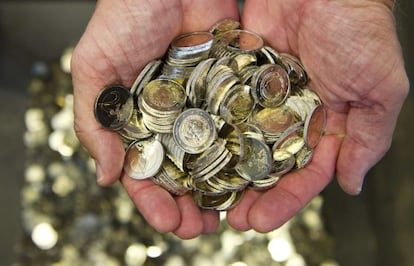
Wage devaluation has pushed Spanish salaries further away from the euro zone average, a recent European study shows.
In 2014, Spanish workers were making an average hourly rate of €15.70, or 27.3 percent less than the €21.60 average in the group of countries with the common currency.
Seven years earlier, in 2008 – when the economic crisis began – that difference was 24.3 percent, according to an analysis of companies with 10 or more workers conducted by Eurostat, the European statistics bureau.
Other EU countries in financial straits adopted similar measures, either out of conviction or imposition
This growing gap not only holds true in a comparison between average hourly wages in Spain and the euro zone, but also those between Spain and the European Union as a whole.
These figures show a reversal of the trend of preceding years by which Spanish salaries were slowly converging with European ones.
Reducing labor costs as a way to improve competitiveness has been one of the goals of Spain’s current conservative Popular Party government, and many reforms have been aimed in that direction.
Other EU countries in financial straits adopted similar measures, either out of conviction or imposition. Domestic devaluation was a goal of the so-called Troika – the International Monetary Fund, the European Commission and the European Central Bank – which set out conditions for bailouts.
The Eurostat figures show that in recent years, other countries have been diverging from euro-zone salaries even more than Spain. The most extreme case is Greece, where the average hourly wage was €13.50 in 2008 – 29 percent less than the average – while in 2013 it was €11.40, or 46.4 percent less than the euro zone average.
Cyprus, Portugal and Italy have also experienced growing wage gaps compared with the group average.
Tu suscripción se está usando en otro dispositivo
¿Quieres añadir otro usuario a tu suscripción?
Si continúas leyendo en este dispositivo, no se podrá leer en el otro.
FlechaTu suscripción se está usando en otro dispositivo y solo puedes acceder a EL PAÍS desde un dispositivo a la vez.
Si quieres compartir tu cuenta, cambia tu suscripción a la modalidad Premium, así podrás añadir otro usuario. Cada uno accederá con su propia cuenta de email, lo que os permitirá personalizar vuestra experiencia en EL PAÍS.
¿Tienes una suscripción de empresa? Accede aquí para contratar más cuentas.
En el caso de no saber quién está usando tu cuenta, te recomendamos cambiar tu contraseña aquí.
Si decides continuar compartiendo tu cuenta, este mensaje se mostrará en tu dispositivo y en el de la otra persona que está usando tu cuenta de forma indefinida, afectando a tu experiencia de lectura. Puedes consultar aquí los términos y condiciones de la suscripción digital.