Spanish politician went easy on TV debate opponent so as to not look “sexist”
Popular Party’s European candidate did not want to appear to be “intimidating a defenseless woman” Arias Cañete says he was worried about abusing his “intellectual superiority” over Socialist rival

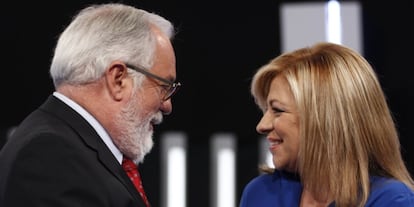
A day after a tepid debate on Spanish television between the top Socialist and Popular Party (PP) candidates to the European Parliament, the real clash took place.
Miguel Arias Cañete, the PP contender in the May 25 vote, claimed that he deliberately held back during the debate so as not to overwhelm his opponent, Elena Valenciano.
“A debate between a man and a woman is a very complicated thing,” said Cañete, 64, on a television program called Espejo Público, which airs on the private network Antena 3. “If you abuse your intellectual superiority, you end up looking like a sexist intimidating a defenseless woman.”
The former agriculture minister added that he deliberately contained himself during the debate, because “if I act like myself, I can get scary, even to myself. I would move in for the kill.”
If I act like myself, I can get scary, even to myself. I would move in to kill”
His opponent, Socialist Elena Valenciano, 53, swiftly replied via Twitter: “So then what? What do we do? We leave women out of the debate?”
The secretary general of the Socialist Party, Alfredo Pérez Rubalcaba, added a message of his own: “Cañete: the sexism of the bad loser.”
Later on Friday, the conservative politician tried to play down his earlier statements with his own Twitter comments. He cited three female PP politicians as examples of the fact that his “party has always believed in women.”
This is not the first time that Cañete has made a controversial statement about women. During Thursday’s debate, Valenciano reminded him of statements he made in 2000 while he was still agriculture minister to the effect that “field irrigation must be handled the way you handle a woman.”
The mayor of Madrid, Ana Botella, was one of the first members of the PP to come out in Cañete’s defense. “We all make lots of statements, and some are more appropriate than others,” said Botella, who has a long track record of unfortunate remarks of her own.
Tu suscripción se está usando en otro dispositivo
¿Quieres añadir otro usuario a tu suscripción?
Si continúas leyendo en este dispositivo, no se podrá leer en el otro.
FlechaTu suscripción se está usando en otro dispositivo y solo puedes acceder a EL PAÍS desde un dispositivo a la vez.
Si quieres compartir tu cuenta, cambia tu suscripción a la modalidad Premium, así podrás añadir otro usuario. Cada uno accederá con su propia cuenta de email, lo que os permitirá personalizar vuestra experiencia en EL PAÍS.
¿Tienes una suscripción de empresa? Accede aquí para contratar más cuentas.
En el caso de no saber quién está usando tu cuenta, te recomendamos cambiar tu contraseña aquí.
Si decides continuar compartiendo tu cuenta, este mensaje se mostrará en tu dispositivo y en el de la otra persona que está usando tu cuenta de forma indefinida, afectando a tu experiencia de lectura. Puedes consultar aquí los términos y condiciones de la suscripción digital.